The short answer
A single change is rarely a crisis. Take it seriously when several signs appear together, especially around a new online contact: secrecy about chats, mood swings tied to messages, being protective of their device38, and unexplained in-game currency, gift cards or gifts3839. If you see a cluster, gently open a conversation rather than confronting. If you suspect grooming, report it to CEOP41.
- What is CEOP?
- The Child Exploitation and Online Protection Command, part of the National Crime Agency. Children, parents and carers can report suspected grooming or sexual abuse at ceop.police.uk/safety-centre.
Behavioural signs to watch for
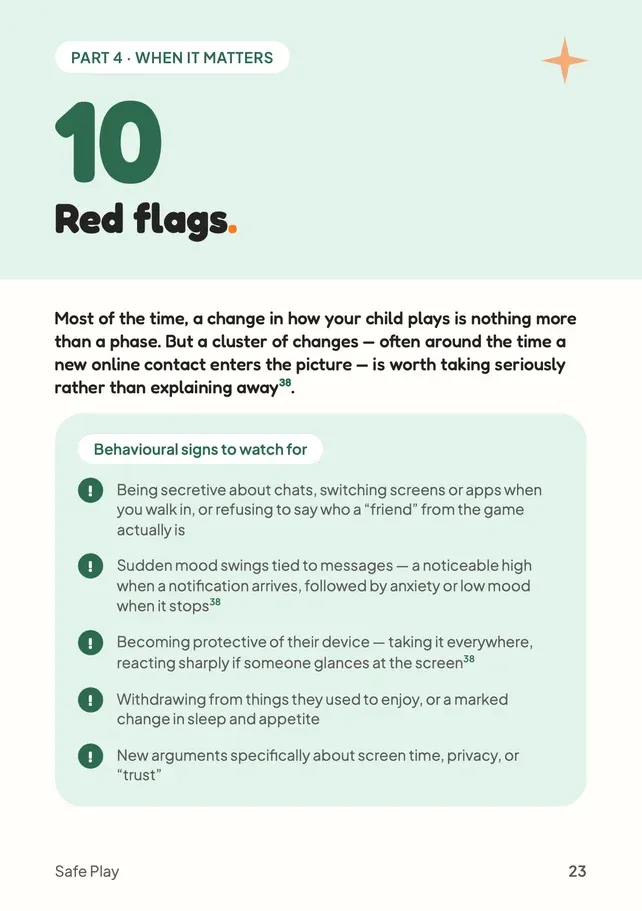
Most of the time, a change in how your child plays is nothing more than a phase. But a cluster of changes, often around the time a new online contact enters the picture, is worth taking seriously rather than explaining away38.
- Being secretive about chats, switching screens or apps when you walk in, or refusing to say who a "friend" from the game actually is
- Sudden mood swings tied to messages: a noticeable high when a notification arrives, followed by anxiety or low mood when it stops38
- Becoming protective of their device, taking it everywhere, reacting sharply if someone glances at the screen38
- Withdrawing from things they used to enjoy, or a marked change in sleep and appetite
- New arguments specifically about screen time, privacy or "trust"
Key facts
Free to quote, with a link to this page
- 7,263
online grooming offences were recorded by UK police in a year, almost double 2017/18 where comparable40.
Source: NSPCC, 2025
- Gifts
Unexplained in-game currency, gift cards or credit on a child's account are a well-known grooming warning sign: groomers often use gifts to build a sense of obligation38.
Source: CPD Online College
- 2+
A cluster of changes, often around a new online contact, matters more than any single sign38.
Source: CPD Online College
Technical and financial signs
- Unexplained in-game currency, gift cards or credit appearing on their account: a well-known grooming warning sign, as groomers often use gifts to build a sense of obligation38.
- A new device or accessory you didn't buy them, often explained away as "a friend gave it to me"39.
- Deleted message histories, or being unable to describe who a contact actually is beyond "someone from the game"39.
- 7,263online grooming offences recorded by UK police in a year, almost double 2017/18 where comparable. Where the platform was known, 40% were on Snapchat40
Chats that start in a game can move to private apps, so watch where conversations go.
How worried should I be?
Match your response to what you're seeing. Most of the time, you'll stay at step one.
Step 1 Notice
If you see: One change, on its own.
What to do: Most of the time it's just a phase38. Keep an eye on it, and stay curious about what they're playing.
Step 2 Talk
If you see: Several signs together, often around a new online contact38.
What to do: Gently open a conversation, without panic or confrontation, so they keep talking to you. Ways to start.
Step 3 Report
If you see: You suspect grooming. Gifts, game currency or credit you still can't explain after talking are a well-known warning sign38.
What to do: Report it to CEOP at ceop.police.uk/safety-centre. If your child is in immediate danger, call 99941.
Myth vs fact
What parents often hear, checked against the sources
Myth
“One odd change means something is seriously wrong.”
Fact
A single sign rarely does. A cluster of changes, often around a new online contact, is what's worth taking seriously38.
The most important part
Notice calmly. Talk gently.
A single sign rarely means something is seriously wrong. But if several appear together, it's a reason to gently open a conversation, not to panic or confront. Your child needs to feel able to keep talking to you, not shut down further.
Many children delay telling a parent because they fear the reaction more than the incident itself45. Whatever you find out, how you respond in the first few minutes matters most.
Opening the conversation
Gentle ways in, without accusing. Save one, or share it with whoever else is raising your child:
- Opening the conversation
You've seemed a bit down after playing lately. Everything okay?
Notice out loud, without accusing. It leaves the door open.

Share - Opening the conversation
Who's the friend from the game? What are they like?
Curious, not suspicious. Listen more than you ask.
Share - Opening the conversation
Whatever it is, you're not in trouble.
Say it before they tell you anything, and mean it.
Share
If you're worried right now
If your child is in immediate danger, call 999. If you suspect grooming, report it to CEOP at ceop.police.uk/safety-centre41. For bullying, hacking or general worry, call the NSPCC Helpline on 0808 800 50004142. Our guide to what to do if something goes wrong has the full steps.
Put it into practice
Actions you can take now
Everything this chapter covers, as a short to-do list you can work through now, while it's fresh.
Quick wins, a few minutes each. Tick them off as you go.
0 of 4 done
Common questions
What are the signs of grooming in online games?
Watch for a cluster of changes, often around a new online contact: secrecy about chats, mood swings tied to messages, being protective of their device38, and unexplained in-game currency, gift cards or gifts3839.
Why are gifts from other players a warning sign?
Unexplained in-game currency, gift cards or credit are a well-known grooming warning sign, because groomers often use gifts to build a sense of obligation38.
How common is online grooming in the UK?
UK police recorded 7,263 online grooming offences in a year, almost double 2017/18 where comparable40. Chats that start in a game can move to private apps, so watch where conversations go.
Should I take my child's device away if I'm worried?
Try a calm conversation first. Your child needs to feel able to keep talking to you, and many children delay telling a parent because they fear the reaction45. If you suspect grooming, report it to CEOP41.
Who do I report suspected grooming to in the UK?
CEOP, at ceop.police.uk/safety-centre. If your child is in immediate danger, call 99941.
Sources
- CPD Online College, Signs of Online Grooming to Watch For · cpdonline.co.uk
- BroadbandSwitch.uk, Warning Signs of Online Harm UK Parents 2026: How to Spot Trouble Early · broadbandswitch.uk
- NSPCC, Data shows how criminals are using private messaging platforms to manipulate and groom children (2025) · nspcc.org.uk
- CEOP (National Crime Agency), Child Exploitation and Online Protection Command: make a report · ceop.police.uk
- NSPCC, NSPCC Helpline · nspcc.org.uk
- Net Psychology, Online Grooming: How Predators Manipulate Children (2026) · netpsychology.org
Page updates
- Chapter 10 published as its own page.