The short answer
Parental controls help, but children can and do bypass them, and researchers found little support for relying on them as a stand-alone safety strategy46. What lasts is active mediation: talking about risks and helping your child use games well, not just blocking49. In practice, ask what a game is actually like, talk through red flags before they happen, and be the person they tell about a weird message.
- What is active mediation?
- Talking with your child about risks and helping them use the internet well, rather than only blocking things.
What parental controls can't do
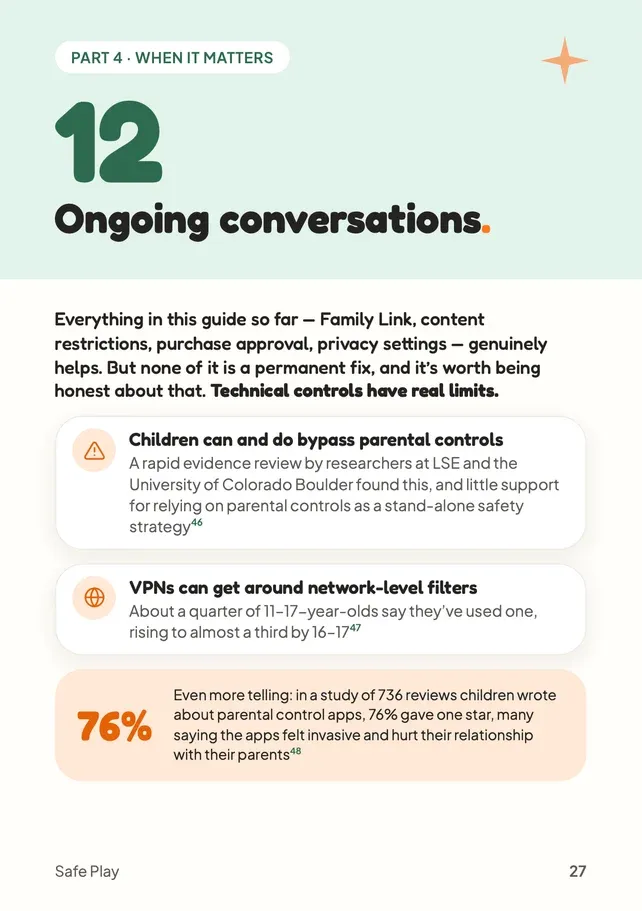
- Children can and do bypass parental controls. A rapid evidence review by researchers at LSE and the University of Colorado Boulder found this, and little support for relying on parental controls as a stand-alone safety strategy46.
- VPNs can get around network-level filters. About a quarter of 11 to 17-year-olds say they've used one, rising to almost a third by 16 to 1747.
- 76%of 736 reviews children wrote about parental control apps gave one star, many saying the apps felt invasive and hurt their relationship with their parents48
Controls are the foundation. Conversation sits on top.
None of this means the controls aren't worth setting up. They are. They work best as a foundation, not a substitute for conversation.
European research led by LSE found that "enabling" mediation, talking about risks and helping children use the internet well rather than just blocking it, goes with stronger digital skills and more opportunities (along with some more risk), while restriction alone cuts risks at the cost of those opportunities49.
Myth vs fact
What parents often hear, checked against the sources
Myth
“Parental controls keep children safe on their own.”
Fact
Children can and do bypass them, and a rapid evidence review found little support for relying on them as a stand-alone safety strategy46.
In practice
Games will keep changing. A relationship won't go out of date.
You don't need a script, or to know every game. What helps is being genuinely curious, often, so talking about games is normal long before anything goes wrong.
What it looks like day to day
Three habits from the guide:
What's this game actually like? Show me.
Genuinely curious, rather than checking up.
What would you do if someone in a game asked you to chat somewhere else?
Talk through a red flag before it happens, not just after.
If you ever get a weird message, I'd rather know than not.
Be the one they tell, not the person they hide it from.
When they push back on the rules
Explain the why behind each setting, and review them together as your child grows. Rules that make sense to a child are easier to live with, for both of you.
Conversation starters to save and share
Six lines from across the guide, one for each of the big risks. Save one for the moment you need it, or share it with whoever else is raising your child.
- Chat and strangers
If anyone asks you to chat somewhere else, that's always a no.
The one rule worth repeating, until it's automatic.

Share - Free games
Is that worth real money, or just game money?
Turning coins back into pounds makes real money feel real again.
Share - Red flags
Whatever it is, you're not in trouble.
Say it before they tell you anything, and mean it.
Share - Permissions
Why do you think a colouring game wants to know where we live?
Turn it into a puzzle. Children are good at spotting things that don't add up.
Share - Dark patterns
Which button do you think buys it?
Children enjoy catching a trick out. It turns them from targets into detectives.
Share - Privacy
Who can see your profile right now? Let's check.
Look together. Children are often as surprised as adults.
Share
Put it into practice
Actions you can take now
Everything this chapter covers, as a short to-do list you can work through now, while it's fresh.
Quick wins, a few minutes each. Tick them off as you go.
0 of 4 done
Common questions
Do parental controls actually work?
They help, but they're not enough on their own. A rapid evidence review found children can and do bypass them, and little support for relying on them as a stand-alone safety strategy46.
What is active mediation?
Talking with your child about risks and helping them use the internet well, rather than just blocking it. LSE-led research found it goes with stronger digital skills and more opportunities49.
Can children get around parental controls with a VPN?
Yes. VPNs can get around network-level filters, and about a quarter of 11 to 17-year-olds say they've used one, rising to almost a third by 16 to 1747.
How do I start talking to my child about online safety?
Start with curiosity: ask what a game is actually like and get them to show you. Talk through red flags before they happen, and make sure they know they can tell you about a weird message without getting into trouble.
Should I stop using parental controls, then?
No. They're worth setting up as a foundation. They just work best alongside regular conversation, not instead of it.
Sources
- Stoilova, M., Bulger, M. & Livingstone, S., Do parental control tools fulfil family expectations for child protection? A rapid evidence review of the contexts and outcomes of use (Journal of Children and Media) (2023) · tandfonline.com
- Department for Science, Innovation and Technology, Children’s circumvention behaviours online (2026) · gov.uk
- Ghosh, A.K. et al., Safety vs. Surveillance: What Children Have to Say about Mobile Apps for Parental Control (CHI 2018) (2018) · doi.org
- Livingstone, S. et al., Maximizing opportunities and minimizing risks for children online: the role of digital skills in emerging strategies of parental mediation (Journal of Communication) (2017) · eprints.lse.ac.uk
Page updates
- Chapter 12 published as its own page, with six shareable conversation starters.