The short answer
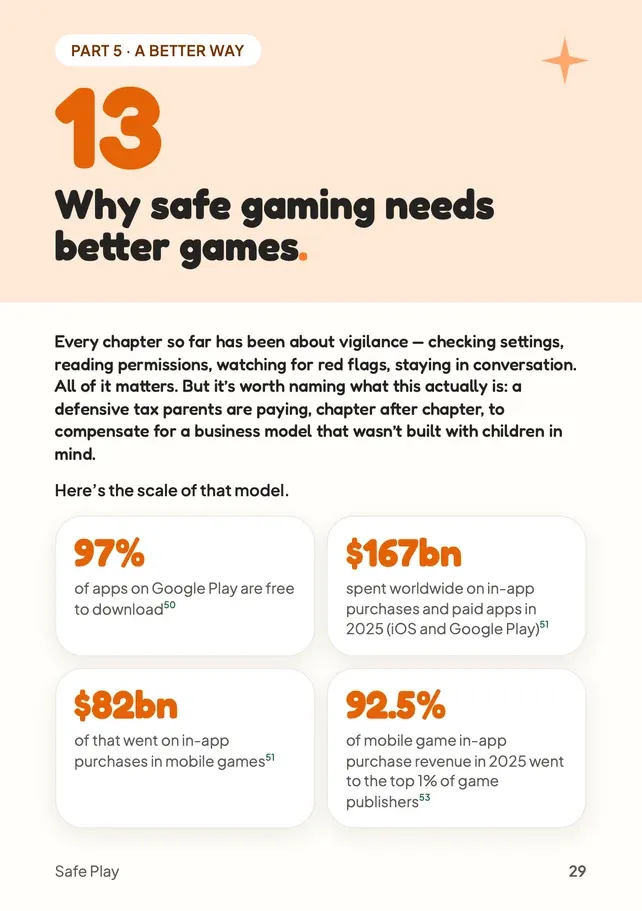
Rarely. 97% of apps on Google Play are free to download50, yet $82bn was spent on in-app purchases in mobile games in 202551, and 92.5% of that revenue went to the top 1% of game publishers53. "Free" means the game makes money another way: ads shown to a captive audience, data collected and shared with third parties, or purchase flows engineered to turn impulse into spend.
- What is a "whale"?
- A high-spending player. A small minority of them drive a hugely disproportionate share of a game's income.
The business model, in four numbers
- 97%of apps on Google Play are free to download50
- $167bnspent worldwide on in-app purchases and paid apps in 2025 (iOS and Google Play)51
- $82bnof that went on in-app purchases in mobile games51
- 92.5%of mobile game in-app purchase revenue in 2025 went to the top 1% of game publishers53
A small minority of high-spending players, often called "whales", drive a hugely disproportionate share of income, while most spend little or nothing52.
Key facts
Free to quote, with a link to this page
"Free" was never really free
It means the game was built to make money some other way:
Ads
Shown to a captive audience.
Ads and dark patternsData
Collected and shared with third parties.
Permissions and dataPurchase flows
Engineered to convert impulse into spend.
In-app purchases
Every chapter in this guide, from reading permissions to spotting dark patterns to locking down purchases, exists because that's the model the vast majority of children's games are built on.
Myth vs fact
What parents often hear, checked against the sources
The most important part
None of this is your fault. The problem is structural.
None of this is a criticism of any parent for not catching everything. A handful of monetisation patterns, repeated across hundreds of thousands of titles, leave parents to detect and defend against them game by game, setting by setting. Vigilance helps enormously. It was never supposed to be the whole solution.
The alternative isn't more settings to configure. It's games built on a different foundation entirely, where the business model doesn't need a child's data, attention or spending to survive.
Talking about it with your child
Children are good at spotting a catch, once they know to look:
If this game is free, how do you think it makes money?
Working it out together builds a skill for life.
Which of your games never asks for anything?
Notice the good ones together, too.
Is that worth real money, or just game money?
Turning coins back into pounds makes real money feel real again.
Put it into practice
Actions you can take now
Everything this chapter covers, as a short to-do list you can work through now, while it's fresh.
Quick wins, a few minutes each. Tick them off as you go.
0 of 4 done
Common questions
Are free games really free?
Rarely. 97% of apps on Google Play are free to download50, but $82bn was spent on in-app purchases in mobile games in 202551. Most free games make money through ads, data or purchases.
How do free mobile games make money?
Through ads shown to a captive audience, data collected and shared with third parties, and purchase flows engineered to turn impulse into spending.
What is a "whale" in mobile gaming?
A high-spending player. A small minority of whales drive a hugely disproportionate share of a game's income, while most players spend little or nothing52.
How can I tell how a free game makes money?
Look under the title on its Google Play listing for the "Contains ads" and "In-app purchases" labels, and check its Data safety section.
Are there games for children with no ads or in-app purchases?
Yes, though they're rare. Look for listings without the "Contains ads" or "In-app purchases" labels. Pumpkin Cat Games is one example: free, with no adverts, tracking, sign-ups or paywalls.
Sources
- 42matters, Google Play Statistics and Trends 2026 (2026) · data.42matters.com
- Sensor Tower, State of Mobile 2026 (2026) · sensortower.com
- Plarium, 50 Revealing Mobile Game Monetization Statistics and Facts · plarium.com
- Game World Observer, In 2025, the revenue of the mobile gaming market grew, but only slightly — analysis (citing Sensor Tower) (2026) · gameworldobserver.com
Page updates
- Chapter 13 published as its own page.