The short answer
Gaming isn't bad for children, but the landscape has shifted. Many free mobile games are built around collecting data, showing ads and encouraging spending, and 31% of 8 to 17s who game online chat with strangers while gaming4. Start with three things: link your child's account to yours with Google Family Link, require approval for purchases9, and turn chat off or to friends only. Then keep talking about what they play.
- What is Google Family Link?
- Google's free parental controls app. Link your child's account to yours to approve downloads and purchases, cap content by age rating and set time limits.
How big a part of childhood gaming has become
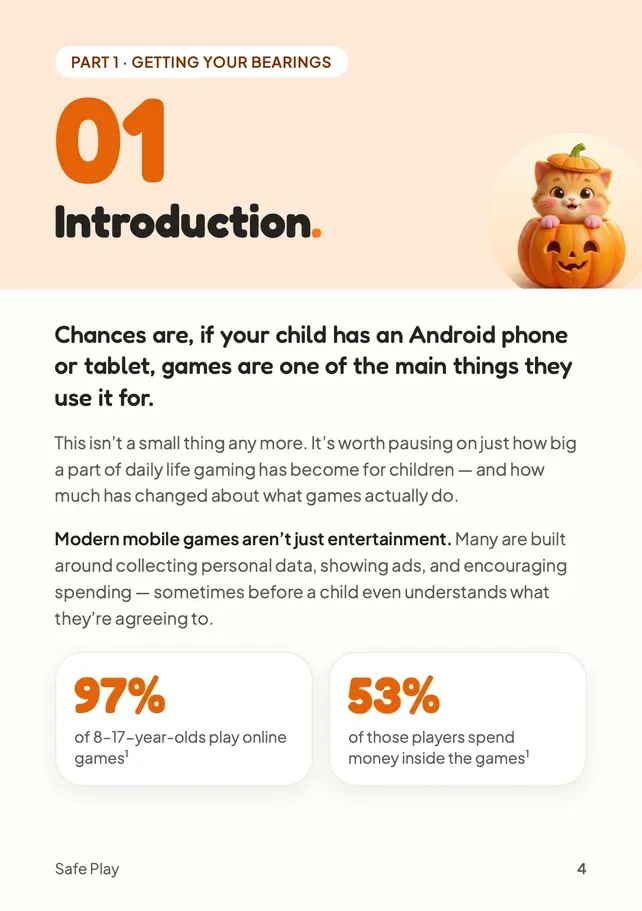
This isn't a small thing any more. Chances are, if your child has an Android phone or tablet, games are one of the main things they use it for.
Key facts
Free to quote, with a link to this page
What modern games actually do
Modern mobile games aren't just entertainment. Many are built around three things, sometimes before a child even understands what they're agreeing to:
Collecting personal data
Permissions, accounts and profiles that are public until you change them.
Permissions and dataShowing ads
Ads, and design tricks that make accidental taps more likely.
Ads and dark patternsEncouraging spending
Coins, gems and loot boxes that make real money feel less real.
In-app purchases
Then there's the social side. Many popular games now include chat, voice calls or open multiplayer lobbies: features that let your child talk to people they've never met.
Myth vs fact
What parents often hear, checked against the sources
Myth
“Gaming is bad for kids.”
Fact
Gaming itself isn't the problem. What's changed is how free games make money, and who children can talk to inside them: 31% of 8 to 17s who game online chat with strangers while gaming4.
The most important part
Gaming isn't the problem. The landscape has shifted.
None of this means gaming is bad for kids. It means the tools and habits that kept children safe a few years ago might not be enough today.
You don't need to become a tech expert to keep up. Settings help, and this guide walks through every one. What lasts is a child who tells you when something feels off.
Easy ways to start talking
You don't need a script. A few openers that work at any age:
What's your favourite game right now? Can you show me?
Start with interest, not rules. Ten minutes playing together tells you more than any settings menu.
Does anyone you don't know ever talk to you in a game?
Ask it casually, early and often, so it's normal long before anything happens.
If a game ever asks you to pay or share something, come and get me.
Agree it as a team rule, not a punishment waiting to happen.
What the guide covers, chapter by chapter
Safe Play has 14 chapters in five parts. Read front to back, or jump straight to what's worrying you.
- 02How to set up Google Family Link for kids' games
- 03Which permissions should a kids' game ask for?
- 04How to stop in-app purchases on Android
- 05How to turn off chat with strangers in games
- 06Dark patterns: the design tricks behind accidental taps
- 07PEGI ratings on Google Play, explained
- 08How much gaming is too much?
- 09Privacy settings for kids' gaming accounts
- 10Red flags: signs something's wrong in a game
- 11What to do if something goes wrong (UK)
- 12How to talk to your child about gaming safety
- 13Are free games really free?
- 14A note from the author
Put it into practice
Actions you can take now
Everything this chapter covers, as a short to-do list you can work through now, while it's fresh.
Quick wins, a few minutes each. Tick them off as you go.
0 of 4 done
Common questions
Are mobile games safe for children?
Gaming isn't bad for children, but many free mobile games are built around collecting data, showing ads and encouraging spending, and many include chat with people your child has never met. With the right settings and an open conversation, the risks are manageable.
How many children play games online in the UK?
Ofcom found 97% of UK 8 to 17-year-olds play games online, and 53% of those players spend money inside the games1.
Do children talk to strangers in online games?
Often. In 2023, 22% of 8 to 17s had talked while gaming to people they didn't know outside the game3, and in 2024, 31% of those who game online chatted with strangers while gaming4.
Where should I start?
Link your child's Google account to yours with Family Link, require approval for downloads and purchases9, and switch off or limit chat in each game. Then keep talking about what they play.
Is this guide only for Android?
The step-by-step settings are written for Android and Google Play. The advice on spending, chat, dark patterns, red flags and talking with your child applies whatever device they use.
Sources
- Ofcom, Top trends from our latest look at UK children’s online lives (2025) · ofcom.org.uk
- 5Rights Foundation, New research reveals how children face financial harm online (2025) · 5rightsfoundation.com
- Ofcom, Children and Parents: Media Use and Attitudes Report (2023) · ofcom.org.uk
- Ofcom, Children and Parents: Media Use and Attitudes Report (2024) · ofcom.org.uk
- Google For Families Help, Purchase approvals on Google Play · support.google.com
Page updates
- Chapter 01 published as its own page.